World Health Organization. Noncommunicable diseases. (2018).
World Health Organization. Global action plan for the prevention and control of noncommunicable diseases 2013–2020. (2013).
The State Council Information Office. The State Council Information Office Held a Briefing on “China’s Population Nutrition and Chronic Disease Status Report (2020)”. (2020).
Kickbusch, I. Health in all policies. BMJ 347, f4283 (2013).
Google Scholar
Gassner, L., Zechmeister-Koss, I. & Reinsperger, I. National strategies for preventing and managing non-communicable diseases in selected countries. Front Public Health 10, 838051 (2022).
Google Scholar
Bauer, U. E., Briss, P. A., Goodman, R. A. & Bowman, B. A. Prevention of chronic disease in the 21st century: Elimination of the leading preventable causes of premature death and disability in the USA. Lancet 384, 45–52 (2014).
Google Scholar
Puska, P., Laatikainen, T., Korpelainen, V. & Vartiainen, E. Contribution of the North Karelia project to international work in CVD and NCD prevention and health promotion. Glob. Heart 11, 243–246 (2016).
Google Scholar
Cheah, J. Chronic disease management: A Singapore perspective. BMJ 323, 990–993 (2001).
Google Scholar
Delany, T. et al. Health in all policies in South Australia: What has supported early implementation?. Health Promot. Int. 31, 888–898 (2016).
Google Scholar
Peytremann-Bridevaux, I. & Burnand, B. Inventory and perspectives of chronic disease management programs in Switzerland: An exploratory survey. Int. J. Integr. Care 9, e93 (2009).
Google Scholar
Willcox, S., Lewis, G. & Burgers, J. Strengthening primary care: Recent reforms and achievements in Australia, England, and the Netherlands. Issue Brief (Commonw Fund) 27, 1–19 (2011).
Google Scholar
The Lancet Public Health, null. China’s health reform: 10 years on. Lancet Public Health 4, e431 (2019).
Kong, L.-Z. China’s medium-to-long term plan for the prevention and treatment of chronic diseases (2017–2025) under the healthy China initiative. Chronic Dis. Transl. Med. 3, 135–137 (2017).
Google Scholar
De Jong, M., Tijhuis, Y., Koelen, M. & Wagemakers, A. Intersectoral collaboration in a Dutch community health promotion programme: Building a coalition and networks. Health Promot. Int. 38, daab207 (2023).
Google Scholar
Adeleye, O. A. & Ofili, A. N. Strengthening intersectoral collaboration for primary health care in developing countries: Can the health sector play broader roles?. J. Environ. Public Health 2010, 272896 (2010).
Google Scholar
Allen, P. et al. Perceived benefits and challenges of coordinated approaches to chronic disease prevention in state health departments. Prev. Chronic Dis. 11, E76 (2014).
Google Scholar
Amri, M., Chatur, A. & O’Campo, P. An umbrella review of intersectoral and multisectoral approaches to health policy. Soc. Sci. Med. 315, 115469 (2022).
Google Scholar
Tumusiime, P. et al. Building health system resilience in the context of primary health care revitalization for attainment of UHC: Proceedings from the Fifth Health Sector Directors’ Policy and Planning Meeting for the WHO African Region. BMC Proc. 14, 16 (2020).
Google Scholar
Bennett, S., Glandon, D. & Rasanathan, K. Governing multisectoral action for health in low-income and middle-income countries: Unpacking the problem and rising to the challenge. BMJ Glob. Health 3, e000880 (2018).
Google Scholar
Emerson, K. Collaborative governance of public health in low- and middle-income countries: Lessons from research in public administration. BMJ Glob. Health 3, e000381 (2018).
Google Scholar
Hearld, L. R., Alexander, J. A., Wolf, L. J. & Shi, Y. The perceived importance of intersectoral collaboration by health care alliances. J. Commun. Psychol. 47, 856–868 (2019).
Google Scholar
Hou, L., Chen, B., Ji, Y., Wang, B. & Wu, J. China CDC in Action—Hypertension prevention and control. China CDC Wkly 2, 783–786 (2020).
Google Scholar
Wang, Z. et al. Changes in chronic disease management among community health centers (CHCs) in China: Has health reform improved CHC ability?. Int. J. Health Plann. Manage 32, 317–328 (2017).
Google Scholar
Dai, B. Does China’s new cooperative medical scheme promote rural elders’ access to healthcare services in relation to chronic conditions?. Int Health 7, 32–41 (2015).
Google Scholar
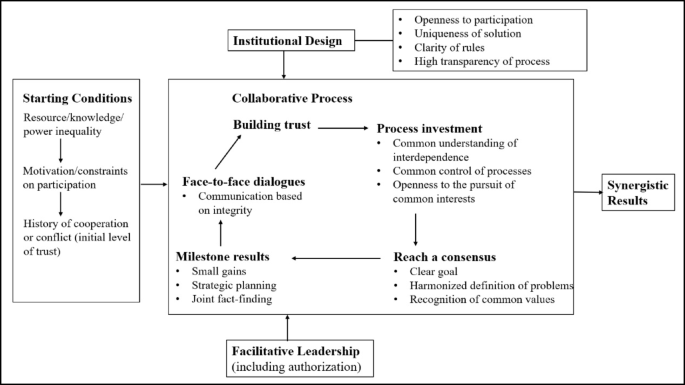
Ansell, C. & Gash, A. Collaborative governance in theory and practice. J. Public Admin. Res. Theory 18, 543–571 (2008).
Google Scholar
Liu, W. & Yang, D. Research on the formation and optimization of the collaborative governance mechanism of Urban catastrophe risk: Based on SFlC model. Urban Dev. Stud. 29, 12–16 (2022).
Joaquín, H. Jr. The multisectoral trilemma of network management. J. Public Admin. Res. Theory 18, 1–31 (2008).
Yan, P., Xiao-ying, D., Ji-miao, W. & Song, D. Research on synergistic governance of cross-border economic cooperation zones in Yunnan Province based on the SFIC model. J. Yunnan Admin. Coll. 21, 125–130 (2019).
Comparative Perspectives on Seattle’s Light Rail Project. Stephen B, P. Theories of Governance. Policy Stud. J. 41, 583–608 (2013).
Tagarev, T., Davis, B. Á. & Cooke, M. Business, organisational and governance modalities of collaborative cybersecurity networks. Multimed. Tools Appl. 81, 9431–9443 (2022).
Google Scholar
Bianchi, C., Nasi, G. & Rivenbark, W. C. Implementing collaborative governance: Models, experiences, and challenges. Public Manag. Rev. 23, 1581–1589 (2021).
Google Scholar
Lumineau, F., Wang, W. & Schilke, O. Blockchain governance—A new way of organizing collaborations?. Organ. Sci. 32, 500–521 (2021).
Google Scholar
Llu, Y. & Wang, Y. Promotion dilemma and strategy of physical-medicaintegration in China based on SFlc model. J. Shenyang Sport Univ. 40, 1–7 (2021).
Yang, Y. & Chen, Y. Research on collaborative path of medical alliance in China based on SFlc model. Health Econ. Res. 39, 52–55 (2022).
Jackson, D. L. Revisiting sample size and number of parameter estimates: Some support for the N: q hypothesis. Struct. Equ. Model. 10, 128–141 (2003).
Google Scholar
Bentler, P. M. & Chou, C.-P. Practical lssues in structural modeling. Sociol. Methods Res. 16, 78–117 (1987).
Google Scholar
Mazzucca, S. et al. Expanding implementation research to prevent chronic diseases in community settings. Annu. Rev. Public Health 42, 135–158 (2021).
Google Scholar
Jiang, Y. et al. Gaps and directions in addressing non-communicable and chronic diseases in China: A policy analysis. Int. J. Environ. Res. Public Health 19, 9761 (2022).
Google Scholar
Xiao, N., Long, Q., Tang, X. & Tang, S. A community-based approach to non-communicable chronic disease management within a context of advancing universal health coverage in China: Progress and challenges. BMC Public Health 14(Suppl 2), S2 (2014).
Google Scholar
Lei, T., Yang, J., Hong, M. & Fu, D. Analysis of medical insurance payment to promote the prevention and control of chronic diseases-based on stakeholder theory. Health Econ. Res. 39, 38–41 (2022).
Jang, Y. et al. Research on the status of multi-sector cooperation innational chronic disease comprehensive control andprevention demonstration areas. Chin. J. Health Policy 12, 59–66 (2019).
Si, X., Zhai, Y., Zhu, X. & Ma, J. Multi-sectoral coordination and social participation forprevention and control of chronic disease in China fromCDC perspective. Chin. J. Prev. Control Chronic Dis. 27, 268–271 (2019).
Zhang, Y. & Qin, J. Challenges and strategies of non-communicable diseaseprevention and control from the perspective of Health inAll Policies: A survey in typical health cities in China. Chin. J. Health Policy 7, 65–69 (2014).
Lucyk, K. Intersectoral action on the social determinants of health and health equity in Canada: December 2019 federal government mandate letter review. Health Promot. Chronic. Dis. Prev. Can. 40, 314–323 (2020).
Google Scholar
Smith, M. J. & Weinstock, D. Reducing health inequities through intersectoral action: Balancing equity in health with equity for other social goods. Int. J. Health Policy Manag. 8, 1–3 (2019).
Google Scholar
Corvalán, C., Reyes, M., Garmendia, M. L. & Uauy, R. Structural responses to the obesity and non-communicable diseases epidemic: The Chilean Law of Food Labeling and Advertising. Obes. Rev. 14(Suppl 2), 79–87 (2013).
Google Scholar
Caballero, S. et al. Eating contexts determine the efficacy of nutrient warning labels to promote healthy food choices. Front Nutr 9, 1026623 (2022).
Google Scholar
Wolfenden, L. et al. A call to action: More collaborative implementation research is needed to prevent chronic disease. Aust. N. Z. J. Public Health 46, 549–553 (2022).
Google Scholar
Duda-Sikuła, M. & Kurpas, D. Barriers and facilitators in the implementation of prevention strategies for chronic disease patients-best practice GuideLines and policies’ systematic review. J. Pers. Med. 13, 288 (2023).
Google Scholar
Baugh Littlejohns, L. K. & Willis, C. D. Collaborative value creation framework: The potential for strengthening intersectoral partnerships in chronic disease prevention. Prog. Commun. Health Partnersh. 12, 463–472 (2018).
Google Scholar
Najafi, M., Mosadeghrad, A. M. & Arab, M. Mechanisms of intersectoral collaboration in the health system: A scoping review. Iran J. Public Health 52, 2299–2312 (2023).
Google Scholar
Xiao, Y., Qiu, Q.-M., Huang, Y.-X. & Zhu, S.-Y. Patients gather in large hospitals: The current situation of Chinese hospitals and the direction of medical reform. Postgrad. Med. J. 98, e43 (2022).
Google Scholar
Liu, J. et al. Primary health institutions preference by hypertensive patients: Effect of distance, trust and quality of management in the rural Heilongjiang province of China. BMC Health Serv. Res. 19, 852 (2019).
Google Scholar
Shen, M., He, W., Yeoh, E.-K. & Wu, Y. The association between an increased reimbursement cap for chronic disease coverage and healthcare utilization in China: An interrupted time series study. Health Policy Plan 35, 1029–1038 (2020).
Google Scholar
Voetsch, K., Sequeira, S. & Chavez, A. H. A customizable model for chronic disease coordination: Lessons learned from the coordinated chronic disease program. Prev. Chronic Dis. 13, E43 (2016).
Google Scholar
Francis, L., Dunt, D. & Cadilhac, D. A. How is the sustainability of chronic disease health programmes empirically measured in hospital and related healthcare services?-A scoping review. BMJ Open 6, e010944 (2016).
Google Scholar
Figueroa, C. A., Harrison, R., Chauhan, A. & Meyer, L. Priorities and challenges for health leadership and workforce management globally: A rapid review. BMC Health Serv Res 19, 239 (2019).
Google Scholar
Malakoane, B., Chikobvu, P., Heunis, J. C., Kigozi, N. G. & Kruger, W. H. Implementing an intervention to improve leadership/management of public healthcare services in the Free State Province, South Africa: Lessons learned. Afr. Health Sci. 23, 469–482 (2023).
Google Scholar
Horváth, C. et al. How management and leadership training can impact a health system: Evaluation findings from a public health management training program in Cambodia. Front. Public Health 9, 784198 (2021).
Google Scholar
Dorji, K., Tejativaddhana, P., Siripornpibul, T., Cruickshank, M. & Briggs, D. Leadership and management competencies required for Bhutanese primary health care managers in reforming the district health system. J Healthc Leadersh 11, 13–21 (2019).
Google Scholar
Xirasagar, S., Samuels, M. E. & Curtin, T. F. Management training of physician executives, their leadership style, and care management performance: An empirical study. Am. J. Manag. Care 12, 101–108 (2006).
Google Scholar
Sims, M. et al. Did smokefree legislation in England reduce exposure to secondhand smoke among nonsmoking adults? Cotinine analysis from the Health Survey for England. Environ. Health Perspect. 120, 425–430 (2012).
Google Scholar
Haw, S. J. & Gruer, L. Changes in exposure of adult non-smokers to secondhand smoke after implementation of smoke-free legislation in Scotland: National cross sectional survey. BMJ 335, 549 (2007).
Google Scholar
Bull, F. & Dvorak, J. Tackling chronic disease through increased physical activity in the Arab World and the Middle East: challenge and opportunity. Br. J. Sports Med. 47, 600–602 (2013).
Google Scholar
Conroy, M. B., Cook, N. R., Manson, J. E., Buring, J. E. & Lee, I.-M. Past physical activity, current physical activity, and risk of coronary heart disease. Med. Sci. Sports Exerc. 37, 1251–1256 (2005).
Google Scholar
Levy, L. B. Dietary strategies, policy and cardiovascular disease risk reduction in England. Proc. Nutr. Soc. 72, 386–389 (2013).
Google Scholar
Rodriguez-Fernandez, R. et al. Current salt reduction policies across gradients of inequality-adjusted human development in the WHO European region: minding the gaps. Public Health Nutr. 17, 1894–1904 (2014).
Google Scholar
Gordon, R. & Anderson, P. Science and alcohol policy: a case study of the EU Strategy on Alcohol. Addiction 106(Suppl 1), 55–66 (2011).
Google Scholar
Veryga, A. 2008-Lithuania’s year of sobriety: alcohol control becomes a priority of health policy. Addiction 104, 1259 (2009).
Google Scholar
Lincoln, P. et al. Conflicts of interest and the UN high-level meeting on non-communicable diseases. Lancet 378, e6 (2011).
Google Scholar
Manandhar, M., Hawkes, S., Buse, K., Nosrati, E. & Magar, V. Gender, health and the 2030 agenda for sustainable development. Bull World Health Organ 96, 644–653 (2018).
Google Scholar
NCD Countdown 2030 collaborators. NCD Countdown 2030: worldwide trends in non-communicable disease mortality and progress towards Sustainable Development Goal target 3.4. Lancet 392, 1072–1088 (2018).
Jelaković, B. et al. Croatian action on salt and health (CRASH): On the road to success-less salt more health. Nutrients 16, 1518 (2024).
Google Scholar
Rashid, S. et al. Availability and readiness of primary healthcare facilities for the management of non-communicable diseases in different districts of Punjab Pakistan. Front. Public Health 11, 1037946 (2023).
Google Scholar
link