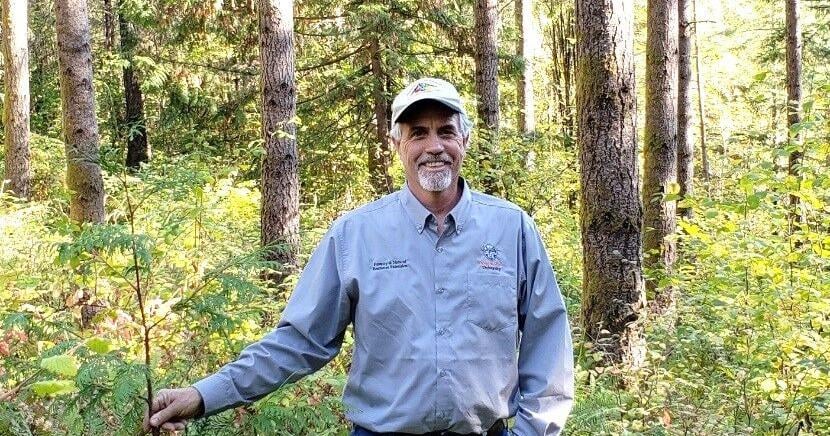
‘Our population is possibly at an all-time high. The average hunter harvests 1.2 deer (per year). We’re encouraging hunters to harvest one more deer or exercise their bag limit.’

DeSoto County black bear: See video of the bear near Nesbit
A black bear was spotted multiple times in North Mississippi as it made its way across DeSoto County and into Marshall County.
- Mississippi saw a record 128 positive chronic wasting disease (CWD) cases in deer during the 2025 sampling year.
- Parts of Pontotoc and Jefferson counties will likely be added to CWD management zones due to new positive cases found near their borders.
- Hunters are encouraged to harvest more deer to help control the spread of CWD, as high deer densities accelerate transmission.
- Regulations within CWD management zones prohibit salt/mineral licks and supplemental feeding, and restrict carcass transportation.
- 10,754 deer tissue samples were tested in 2025, also a record high.
A record number of chronic wasting disease cases were found in Mississippi’s deer herd in the 2025 sample year and two counties, at least in part, may be added to CWD management zones.
Chronic wasting disease sample years run from July 1 through June 30 of each year and since 2019, the number of tissue samples from deer that have been submitted and tested for the disease has hovered around 8,000 each year. In the 2025 sample year, which ended June 30, the number of samples rose to 10,754.
“We had a record year for the number of samples, which is great,” said Russ Walsh, Wildlife chief of staff with the Mississippi Department of Wildlife, Fisheries and Parks. “We’re very appreciative of our hunters and our taxidermists for providing those samples.”
Not surprisingly, it was also another record year for the number of samples that tested positive for the disease as it has done almost every year since the disease was discovered in Mississippi. During the 2025 sample year, 128 samples tested positive. That was up from the previous record of 111 in 2024.
Although Walsh said the number of positives didn’t skyrocket, he said it is clear that the disease is spreading.
Two Mississippi counties to be added to CWD management zones
Two cases od CWD found in 2025 will expand two of the state’s three CWD management zones. In the North CWD Management Zone, Union County produced its first positive sample. That doesn’t affect Union County because it was already in the management zone due to multiple cases of the disease discovered nearby.
However, because the positive was found near Pontotoc County, it will bring part, if not all, of Pontotoc County into the management zone.
A similar situation is unfolding in the Issaquena CWD Management Zone. A new case was discovered in Claiborne County during the 2025 sample year. Claiborne County was already in the management zone, but the positive was found near Jefferson County, which will bring part or possibly all of Jefferson County into the Issaquena CWD Management Zone.
What those two zones will look like for the coming deer seasons is being discussed.
“We should know that before the end of the month,” Walsh said.
What is chronic wasting disease or ‘zombie deer disease’?
Chronic wasting disease affects white-tailed deer and other species such as moose, elk and caribou. It’s a neurological disease with no known cure or vaccine and it’s considered to be always fatal. Unlike some other diseases that affect deer, this one kills slowly. It can take one to two years before a deer dies from it.
The first known case of the disease in Mississippi was discovered in 2018. Since, there have been 446 cases detected. In the 2025 sample year, there was a record 10,754 tissue samples tested and a record 128 cases detected.
To slow the spread of the disease, MDWFP is attempting to isolate it as best as can be done. Where the disease is known to be present, CWD management zones have been created with special regulations to reduce transmission of the disease.
What can Mississippi deer hunters do to slow the spread of CWD?
Hunters in CWD management zones and those outside can both play roles in helping to manage the disease. For those hunting in management zones, adhering to the regulations that are in place can help slow the spread.
For hunters in and outside of management zones are asked to harvest more deer because according to MDWFP, the disease spreads more quickly when deer population densities are high.
“Our population is possibly at an all-time high,” Walsh said. “The average hunter harvests 1.2 deer (per year). We’re encouraging hunters to harvest one more deer or exercise their bag limit.”
What is banned in a CWD management zone?
- Salt licks
- Mineral licks
- Supplemental feeding
- Transportation of deer carcasses outside the zone
What parts of a deer can be taken out of a CWD zone?
- Cut/wrapped meat
- Deboned meat
- Hides with no head attached
- Bone-in leg quarters
- Finished taxidermy
- Antlers with no tissue attached
- Cleaned skulls or skull plates with no brain tissue
- Hunters may transport deer heads to permitted taxidermists participating in the CWD collection program. A CWD sample number must be obtained from a participating taxidermist prior to transporting a deer head outside of the CWD management zone.
What counties are in the Issaquena CWD Management Zone?
The Issaquena CWD Management Zone currently includes:
- Claiborne County
- Issaquena County, east of the Mississippi River and south of MS 14
- Warren County
What counties are in the Harrison CWD Management Zone?
Portions of Hancock and Harrison counties are included and defined as:
- All portions of Harrison County west of U.S. 49
- All portions of Hancock County east of MS 53, MS 603 and MS 43
- All portions of Hancock County east of Nicholson Avenue
What counties are in the North CWD Management Zone?
The North CWD Management Zone includes all portions of the following counties:
- Alcorn County
- Benton County
- Desoto County
- Lafayette County
- Marshall County
- Panola County
- Prentiss County
- Tate County
- Tippah County
- Tishomingo County
- Union County
Portions of Coahoma, Quitman and Tunica counties are also included and are defined as:
- Areas south of MS 4
- Areas east of Old Highway 61 to the intersection of U.S. 49
- Areas east of U.S. 49 to the intersection of U.S. 278
- Areas north of U.S. 278
- Areas west of MS 3
Do you have a story idea? Contact Brian Broom at 601-961-7225 or [email protected].
link