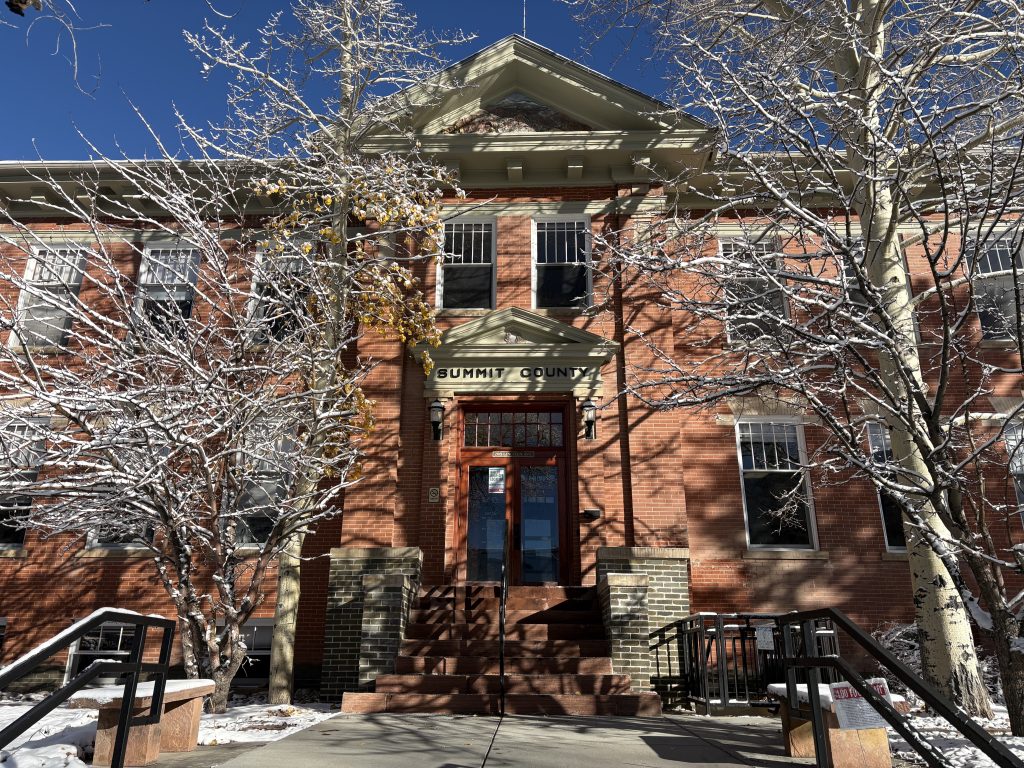
Kyle McCabe/Summit Daily News
Staff from Summit County’s environmental health department presented to the Summit Board of County Commissioners at a Jan. 13 work session about updates they plan to make to regulations regarding pools and on-site water treatment systems.
The department spoke to the board in September about the pool regulations, which will replace ones last updated in 1998 and be based on the Centers for Disease Control and Prevention’s Model Aquatic Health Code. The department wants to update on-site water treatment system regulations to align them with state regulations that were updated in 2025.
Pool regulations
Seth Danner, a senior environmental health specialist, leads water health programs for the department. He told the commissioners that the current pool regulations being from 1998 creates issues when people building or renovating pools want to do something that was not viable and therefore not permitted nearly 30 years ago.
“We have hot tubs that want to be against the wall, or have a fire pit on one side, or infinity edges,” Danner said. “Things that folks see that are really common in pool and spa design, but are not allowed due to our (regulations), because they’re from 1998.”
Danner said the Model Aquatic Health Code is a “strong nationwide standard” developed with input from public health and pool industry experts. The commissioners in September gave the environmental health department direction to move forward with the regulation changes, and the department has since held three stakeholder meetings, Danner said.
The department received generally positive feedback, Danner said. He outlined one common ask from stakeholders, which was that the regulations allow people other than engineers, like architects, to approve “nonsubstantial alterations.”
Danner said the only feedback he has heard since the third stakeholder meeting was people excited for the new regulations asking when they will go into effect.
Commissioner Nina Waters asked if the changes will increase workload for the department. Danner said the department does not do regular pool inspections, rather it ensures code compliance when someone builds a new pool or performs a major renovation. He said he does not anticipate the regulation update increasing the department’s workload.
Waters also asked if the regulations might lead to increased energy or water usage in Summit County by making it easier to build pools and hot tubs. Danner said they could have the inverse effect, as they allow for more modern, more efficient equipment. Environmental health manager Dan Hendershott said the department could look into ways to incentivize pool owners to upgrade equipment even when they are not planning a renovation.
On-site water treatment system regulations
Henderschott said about 10% of residences in Summit County have on-site water treatment systems, or septic systems, that cleans wastewater and puts it into the ground, where it will likely be brought back to the surface by a private well.
Local public health agencies have to follow minimum state regulations, which the state updated in June 2025, Henderschott said. Local agencies have a year to update their regulations, so the county environmental health department has been working on the updates and holding stakeholder meetings.
Henderschott said his department’s changes also look to align with the state regulation’s format, so the document with proposed changes notes which ones come from the state regulation change and not from formatting updates. Most of the state changes are about soil, he said.
The type of soil around a system matters, Henderschott said, because different soils absorb water at different rates. The regulation changes have to do with identifying soils, aiming to make systems last as long as possible, he said.
“Soil is as much an art as it is a science,” Henderschott said. “We’re continuing to learn more and more about soils.”
The proposed changes include other local considerations as well, like allowing a property to be transferred between immediate family members without requiring a septic system inspection, Henderschott said.
County staff recommended the department consider changes to its fee structure for septic system inspections, adding a fee for design revisions. Henderschott said the department often reviews a plan, makes comments and receives revisions from the applicant that do not address all the comments.
“We’ve gone back and forth with designers, eight, nine, 10 times before we get to a point where we can permit something,” Henderschott said.
The fee could deter applicants to “be more responsible” with their first design submission, Henderschott said. The commissioners expressed approval for the idea of getting as much cost recovery as possible for groundwater safety regulation work.
Henderschott said his department looks to finalize on-site water treatment system regulation changes before the 2026 building season starts, so it plans to bring the regulations back in front of the board at a Jan. 27 meeting. The commissioners said they were fine with the expedited schedule as long as the stakeholder process, which has not been completed, is not rushed.
link